What is SRT?
SRT stands for Secure Reliable Transport, it is an open source video transport protocol that provides a secure and reliable solution for low latency video transport. The protocol features:
- Encryption – AES 128/256-bit end to end security.
- Packet Loss Recovery – Advanced low latency retransmission techniques to recover lost packets in low latency scenarios
- Timing Recovery – Keeps audio and video streams in sync even in unstable conditions
- Simplified Firewall Traversal – Works well within restrictive networks and corporate firewalls
- Network Health Monitoring – tracks packet loss, latency, and jitter between endpoints
SRT is optimised for packet loss recovery, jitter control, encryption, and resilience over any IP network.
SRT Output
MediaCP Cloud Video provides SRT Destination alongside its other publishing options (YouTube, Facebook, Twitch, Icecast and Custom RTMP). This allows broadcasters to stream any platform or stream location that provides an SRT host. It is popular among satellite providers, TV stations and IPTV, giving broadcasters a reliable, direct route to send their stream.
Why Use SRT?
SRT is increasingly required by satellite providers and IPTV platforms as a delivery protocol. Having SRT Destination built into MediaCP Cloud Video means broadcasters can meet that requirement using a publisher, directly from the panel with simple setup and management.
How to Use SRT Destination
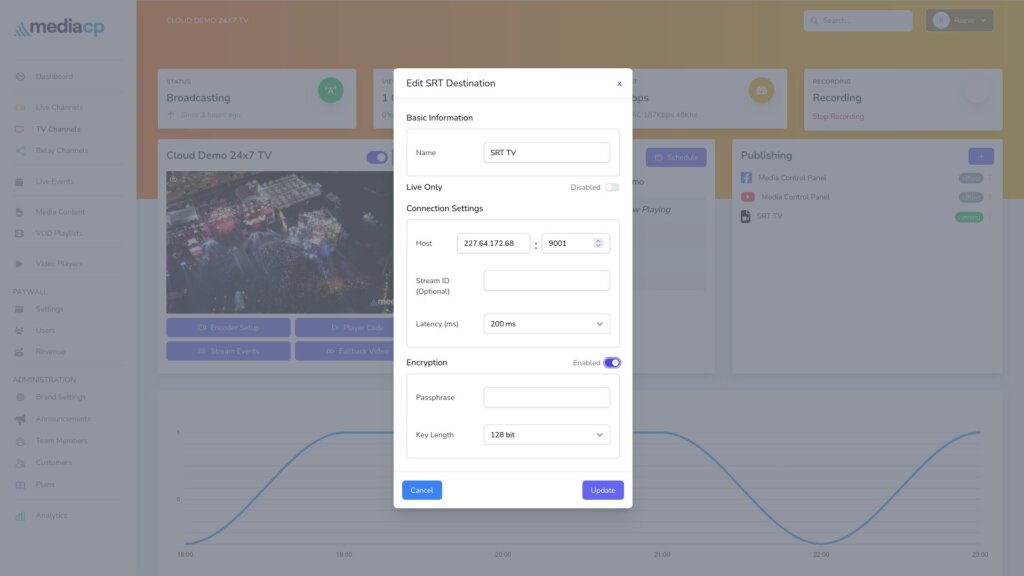
When streaming with MediaCP Cloud Video, sending your broadcast to other locations is handled through a set of powerful Publishers covering YouTube, Facebook, Twitch, Icecast Server, Custom RTMP, and SRT Destination. Publishers act as exit points for your stream to allow it to be seen on other platforms and locations outside of the standard player and HLS output.
To get started, create a new publisher by selecting the plus button and select SRT Destination. From there you’ll see options for the host, port, latency, and optional encryption. On TV Channels there is the additional option of Live Only which allows you to choose if the publisher should stream uploaded scheduled content or only live encoder connections. Once these have been provided the publisher will start and stop automatically with your broadcast and provide a stable stream to your destination.